


Good morning. It’s Thursday, October 15.
Citizen Lab says an Israeli ad company turned ordinary targeted ads into a delivery system for zero-click spyware, and Google has already cut it off. It is the first documented case in the wild of phones being infected this way, with no click from the target.
Today we are covering:
Citizen Lab exposes AdFection, a campaign that used targeted ads to deliver zero-click spyware
A federal appeals court lets Florida enforce its law barring children under 14 from social media accounts
Ledger unveils the Atom, an Android companion device, while it investigates tampered wallets
Flock CEO tells TechCrunch Disrupt that “we shouldn’t pause progress” on surveillance
Nvidia’s RTX Spark inside the Surface Laptop Ultra beats an M5 Max MacBook Pro in local AI tests
Let’s dive in

‘Nightmare Scenario’: Zero-Click Spyware Is Infecting Phones via Targeted Ads
By Matt Burgess via WIRED
Citizen Lab published research on AdFection, which it calls the first in-the-wild demonstration of zero-click mercenary spyware delivered through targeted ads. An Israeli company, Discover-Tech, ran the ad platform, and devices at Al Jazeera were infected with Candiru spyware.
When an ad loads, the user’s ad identifier and IP address go to Discover-Tech’s servers. If the person is selected as a target, the device receives malicious JavaScript that exploits it, and the ads themselves carry no exploit code, which helped them avoid detection by ad platforms.
Discover-Tech ads sent millions of devices in dozens of countries to its servers, including networks tied to governments in 24 countries. Google and Beeswax cut its access, and IAB Europe removed it from its vendor list, while Citizen Lab says industry self-regulation failed to catch it.
𝕏: NEW @citizenlab report We uncovered an Israeli firm using online ads to run vast spy operation This is the first-ever public confirmation of zero-click mercenary spyware delivered via targeted ads. 45 devices at @AJEnglish confirmed infected - profdeibert (@RonDeibert)

Florida can enforce state law barring young kids from social media, appeals court rules
By Diana Novak Jones via Reuters
The 11th Circuit reversed the injunction that had blocked Florida’s HB 3, so the state can enforce a law that bars children under 14 from holding accounts on platforms with addictive features and requires parental consent for 14- and 15-year-olds.
Judge Kevin Newsom wrote that the law implicates the First Amendment but likely survives intermediate scrutiny because it is content-neutral, and he described it as a “conditional ban” aimed at features like infinite scroll, push notifications and auto-play.
The tech groups CCIA and NetChoice, whose members include Meta’s Facebook and Instagram, Google, Snapchat and Pinterest, challenged the law. NetChoice says it is evaluating all of its options, and the litigation continues.
𝕏: Not good news, but grateful that @NetChoice and @Paul_Taske will continue this fight. To ban under-14s the platforms have to know the age of every user. To get parent permission for 15 and 16s will require some way to link the parent and child relationship… - Julie Barrett (@juliecbarrett)
The best way to reach new readers is through word of mouth. If you click THIS LINK in your inbox, it’ll create an easy-to-send pre-written email you can just fire off to some friends.
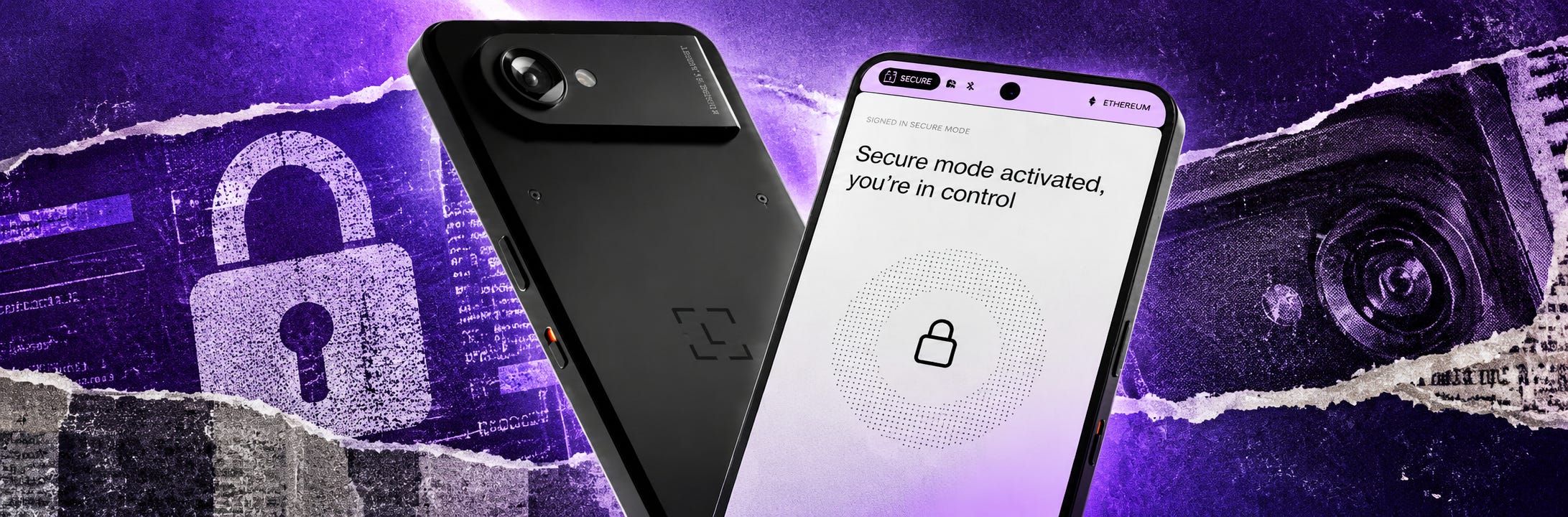
Ledger’s new hardware wallet is an Android phone without the phone
By Dominic Preston via The Verge
Ledger unveiled the Atom, an Android-based device that looks like a phone but is meant to sit beside one. It costs $849 in a limited Founder’s Edition and $899 afterward, and deliveries are expected in summer 2027.
The Atom switches between a Standard Mode for everyday apps and a Secure Mode for signing transactions, backed by a secure element, and a physical switch cuts power to the cameras and microphone. It will also host the Solana Mobile Seeker app.
The launch comes as Ledger investigates modified hardware wallets sold through a reseller in Southeast Asia, where an implant could capture recovery phrases. Onchain researchers link more than $86 million in suspected losses, a figure Ledger has not confirmed.
𝕏: Today marks a new chapter for @Ledger. We’re introducing Ledger Atom™️, a security and privacy device built to protect everything you value. Ledger Atom runs your everyday apps, with a secure chip, a secure screen, and Ledger OS™️ for the moments that matter. Your money. Your identity. Your messages. Your agents. Everything important to you, secured by Ledger. - Pascal Gauthier @Ledger (@_pgauthier)

Flock CEO defends surveillance technology amid national backlash: ‘We shouldn’t pause progress’
By Sarah Perez via TechCrunch
Flock founder and CEO Garrett Langley defended the company’s license plate cameras and other recording devices on a panel at TechCrunch Disrupt 2026 in San Francisco, arguing that if society wants higher odds of accountability for crime, “we shouldn’t pause progress.”
Criticism has led to cancelled contracts and layoffs at Flock. Langley blamed some cancellations on misinformation, such as a customer who believed the cameras use facial recognition, which they do not, though they can detect and track people.
Langley said Flock is “far from perfect” and compared it to driverless cars, but when pressed on abuse and invasiveness, he offered few specifics, saying “we don’t want to tell city leaders how to do their job.”
𝕏: “is to shut down driverless cars. The answer is to say, ‘Hey, let’s talk about how we prevent more accidents in the future’.” But driverless car makers don’t shrug their shoulders at crashes; the companies pause their fleets and apply fixes. - DeFlock (@therealDeFlock)

We test the RTX Spark Superchip in Microsoft’s Surface Laptop Ultra: Nvidia’s Windows on Arm platform impresses in local AI, but gaming isn’t its strong suit
By Jeffrey Kampman via Tom’s Hardware
Tom’s Hardware tested Nvidia’s RTX Spark platform in the 15-inch Surface Laptop Ultra, which has 128GB of memory and lists for $5,899 with 1TB of storage, with lead times stretching to late December.
On a new local AI benchmark that measures how long agentic tasks take to finish, the Surface was fastest in the Qwen dense model test, while a 14-inch MacBook Pro with an M5 Max took about 25% longer. In a second test, the Surface finished in 8 minutes versus 10 for the MacBook Pro.
Gaming is weaker because most games run through Prism emulation, with higher latency and at least one major hang in testing, and the MediaTek Arm CPU trails the M5 Max. The reviewer advises waiting for the software to mature unless you are an early adopter.
Trending in AI
Today’s big AI theme: Legal and financial pressure on the AI giants grows, from eight states suing OpenAI to Bank of America paying for Mythos fixes.
Apple, OpenAI Head to Court in High-Stakes AI Trade Secret Fight
Bank of America hired 1,000 contractors to patch software flaws exposed by Anthropic’s Mythos
Anthropic tells investors quarterly revenue up nearly 50% to $16.8bn ahead of IPO
Thanks for reading to the bottom and soaking in our Newslit Daily, fueled with highlights for your morning.
I hope you found it interesting and, needless to say, if you have any questions or feedback, let me know by hitting reply.
Take care and see you tomorrow!
How was today’s email?


